15 Colorado Ski Resorts For A Winter Getaway

Updated: Sep 11
I've skied a good chunk of these mountains myself over the past ten years living in Colorado, and I still find something new almost every season.
This state has more ski resorts than any one person could hit in a single winter, so I put together this list with the details that actually matter when you're planning a trip.
I included which pass you need, what a day pass costs, how far you're driving or flying to get there, and what kind of terrain you're actually going to find once you're up there.
I threw in some of my own notes too: the good, the humbling, and the one time I broke my arm and still went back for more.
Here are 15 Colorado Ski Resorts to add to your travel list
1. Aspen: Snowmass, Buttermilk, Highlands, Ajax

Aspen is probably the most world known ski destination in Colorado, and it earns its reputation. There are four mountains here: Snowmass, which gets almost 300 inches of snow a year and has over 3,100 acres of terrain across 20 lifts, Buttermilk, home to the X Games and a great terrain park, plus Aspen Highlands and Aspen Mountain. Snowmass and Buttermilk both offer a solid mix for beginner and intermediate skiers, while Highlands leans harder and more advanced.
Pass: Ikon Pass (Aspen's own Premier season pass includes a complimentary Ikon Base Pass)
Day pass: Dynamic pricing, expect somewhere around $200 to $280 depending on the day
Getting there: About 200 miles, roughly 3.5 to 4 hours from Denver, or fly directly into Aspen/Pitkin County Airport (ASE)
Staying in Aspen can be pricey, but that's because you're getting world-class hotels, an incredible dining scene, and high-end shopping. It's a celebrity desitnation for a reason.
Notable mention: Aspen Mountain (Ajax) Ajax deserves its own callout because it's not messing around. It's the mountain right in downtown Aspen, and it has zero beginner terrain, none. It's steep, narrow, and there's no easing into it. This is genuinely one of the hardest mountains I have ever skied, pure advanced and expert terrain from top to bottom. If you're confident on black diamonds elsewhere and want to get humbled a little, this is the place.
2. Vail Ski Resort

Vail is one of my favorites! It's a higher mountain town, sitting close to 12,000 feet, and it gets over 350 inches of snow a season across 5,300+ acres and 31 lifts. The legendary Back Bowls are the reason people fly in from all over the world! They have seven mostly treeless bowls that are pure fun.
Pass: Epic Pass
Day pass: Dynamic pricing, expect $200 to $300+ on peak days
Getting there: About 100 miles, roughly 2 hours from Denver via I-70, or fly into Eagle County Regional Airport (EGE), about 35 minutes from the mountain
Terrain: Roughly 18% beginner, 29% intermediate, 53% advanced and expert
Vail also has one of the best nightlife scenes of any mountain town in Colorado. If you're into that side of a ski trip, John Summit's Experts Only party and Chasing Rabbit, the infamous nightclub, are both worth building a night around. Expect to pay to park.
3. Breckenridge Ski Resort

Breck is a world known ski town with a mountain that genuinely serves every level of skier. It has 20 lifts across nearly 2,900 acres, and it's in Summit County right next to Keystone and Copper, so you've got options if you want to mix up your days.
Pass: Epic Pass
Day pass: Dynamic pricing, expect $180 to $250 depending on the day
Getting there: About 85 miles, roughly 1.5 to 2 hours from Denver via I-70 Terrain: Roughly 14% beginner, 31% intermediate, 55% combined advanced and expert
Downtown Breckenridge looks like something out of a movie. It has great food, some nightlife, shopping, art galleries, and breweries for someone who doesn't want to ski.
When you're tired but not done for the day, head to Peak 8 for a DJ and a beer, it's the perfect way to ease into après. There's also a real party scene on the mountain if you go looking for it, the T-Bar at the base gets lit most afternoons. One heads up: parking near the good lots often requires a paid pass, so budget for that or plan on taking the free bus or shuttle in from the free lots.
4. Copper Mountain

Copper is a fun one to visit any time of year, but I have a personal soft spot for it, and also a personal injury story. I broke my arm at Copper a few seasons back, and it's still one of my favorite mountains despite that. They took genuinely great care of me at their onsite medical clinic, fast, calm, no drama, and I was back on my feet in no time. I also love Copper's music events, they've hosted Daily Shred a few years running, where the artist Daily Bread did surprise mountain pop up sets. If you catch one of those, stay for it.
Pass: Ikon Pass
Day pass: Dynamic pricing, expect $150 to $220 depending on the day
Getting there: About 75 miles, roughly 1.5 hours from Denver, right off I-70
Terrain: A good natural mix, the mountain is basically divided left to right by ability, beginner terrain to the west, intermediate in the middle, advanced and expert to the east.
Copper sees over 275 inches of snow a season across 22 lifts and 2,400+ acres. It's right by Breckenridge, Silverthorne, Dillon, and Frisco, so it's easy to combine with a Summit County trip.
5. Telluride Ski Resort

Telluride is often rated the number one ski resort in Colorado, and the small town charm paired with San Juan Mountain views makes it easy to see why. It's in the part of the state people call the Swiss Alps of Colorado.
Pass: Epic Pass partner resort (up to 7 days on the full Epic Pass, no access on Epic Local) Day pass: Dynamic pricing, expect $200 to $260+ depending on the day
Getting there: About 330 miles, roughly 6 hours from Denver, or fly into Telluride Regional Airport (TEX) or Montrose Regional Airport (MTJ), about 65 miles away with more frequent flights
Terrain: Telluride uses six difficulty ratings instead of the usual three, and the mountain skews toward the harder end overall.
Telluride is more off the beaten path than the I-70 resorts, which is part of the appeal. Taking the free gondola up into town for the first time is a full Colorado experience on its own.
6. Crested Butte Ski Resort

Crested Butte is gorgeous and genuinely off the beaten path, but it's worth the journey. In the summer, it's known as the birthplace of modern downhill mountain biking, and in the winter, it has a reputation for steep, no nonsense terrain once you get past the lower mountain.
Pass: Epic Pass
Day pass: Dynamic pricing, expect $150 to $210 depending on the day
Getting there: About 230 miles, roughly 4.5 hours from Denver, or fly into Gunnison-Crested Butte Regional Airport (GUC), about 30 minutes away
Terrain: Beginner and intermediate friendly lower mountain, with genuinely extreme, steep terrain up high for experts
Lodging ranges from full resorts to cozy condos, and you can expect nothing but big views the whole way up.
7. Keystone Ski Resort

Keystone is a locals' mountain through and through, and it's got a lot of hidden terrain that first timers never find, tucked away bowls and glades off North Peak and the Outback that don't get talked about enough. It's also the second largest mountain in the state by terrain, just behind Vail.
Pass: Epic Pass
Day pass: Dynamic pricing, expect $150 to $200 depending on the day
Getting there: About 75 miles, roughly 1.5 hours from Denver, in Summit County alongside Breckenridge and Copper
Terrain: A strong beginner and intermediate base with long groomers, plus advanced high alpine terrain off the Bergman and Erickson Bowls.
I'll be honest, last season was a rough one for Keystone, which is the only time I have personally been there. That said, I still think it's one of the most underrated mountains in the state, especially if you're after that local, no frills feel without the Vail or Breck crowds. Keystone also has night skiing, which most Colorado resorts don't offer. I hope to go back on a powder day!
8. Loveland Ski Area

Loveland is the closest mountain to Denver, which makes it a great choice if you also want to hang out in the city. It has 10 lifts and 1,800 acres, and it's usually the first mountain to open and the last to close in Colorado, with a season that can stretch into the summer.
This is where I learned to ski! They have great pricing for the beginner only lift section if you are learning.
Pass: Independent, on the Indy Pass (2 days) and the Powder Alliance
Day pass: Generally $90 to $130, one of the more affordable options on this list
Getting there: 53 miles, about an hour from Denver, right before the Eisenhower Tunnel on I-70
The summit sits over 12,700 feet with incredible views once you make it up there, and most lifts serve both easy and difficult terrain, so it's a genuinely good mountain for mixed ability groups. Nearby towns Dillon, Georgetown, and Idaho Springs all have good food and lodging if you want to stay close.
9. Steamboat Ski Resort

Steamboat is a top rated destination that pulls skiers and riders in from all over the world. It gets the second most snow in the state at 368 inches a season, spread across almost 3,000 acres and 18 lifts, and it's got great ski in, ski out lodging.
Pass: Ikon Pass
Day pass: Dynamic pricing, expect $180 to $240 depending on the day
Getting there: About 160 miles, roughly 3 hours from Denver, or fly into Steamboat/Hayden Yampa Valley Regional Airport (HDN), about 25 minutes from town Terrain: A wide mix across the mountain, well suited to a longer trip with every ability level in the group
Downtown Steamboat Springs has a cute, lived in feel with great hotels, dining, and shopping. And after a day on the mountain, Strawberry Hot Springs, a naturally fed remote hot spring, is one of the best soaks in Colorado. If you're anywhere near Steamboat, put it on your list.
10. Monarch Mountain

Monarch is a smaller mountain near Salida that flies under the radar, and I mean that as a compliment. It's not right off a major highway, so the crowds and traffic are nowhere close to what you'll find at the bigger resorts, even though the terrain and views hold up.
Pass: Independent, not on Epic, Ikon, or Indy
Day pass: Generally $90 to $115, one of the more budget friendly options on this list Getting there: About 170 miles, roughly 3.5 hours from Denver
Terrain: 800 acres and 7 lifts with a genuinely good spread for beginner through advanced skiers, and long runs with Continental Divide views.
Salida is a great home base, with hotel options that often come with hot tubs or hot springs. Nearby, you'll also find the world class Mount Princeton Hot Springs Resort, along with a few private chalet hot spring options.
11. Wolf Creek Ski Resort

Wolf Creek gets more snow than any other resort in Colorado, just under 400 inches a year, more than Vail or Aspen. It's in the San Juan Mountains in Southern Colorado, close to the New Mexico border, and it stays independent on purpose.
Pass: Independent, not affiliated with any major multi mountain pass
Day pass: Generally $89 to $109, one of the most affordable options on this list
Getting there: About 280 miles, roughly 5.5 to 6 hours from Denver, or fly into Durango-La Plata County Airport (DRO), about 75 miles away
Terrain: Roughly 20% beginner, 35% intermediate, 25% advanced, 20% expert.
Wolf Creek is right by the cute mountain town of Pagosa Springs. Downtown Pagosa has a world class hot spring resort sitting right on the river, and if you stay there, you get unlimited 24 hour hot spring access. Ski all day, soak all night.
12. Beaver Creek Ski Resort

Beaver Creek is smaller than the mega resorts, but the terrain and accommodations are just as elite. It sees over 325 inches of snow a season across 25 lifts and 1,800+ acres, with a terrain park and cross country options too.
Pass: Epic Pass
Day pass: Dynamic pricing, expect $220 to $270 depending on the day
Getting there: About 105 miles, roughly 2 hours from Denver, or fly into Eagle County Regional Airport (EGE), about 15 to 20 minutes away, the closest airport on this list to the mountain
Terrain: Roughly 19% beginner, 43% intermediate, 38% advanced and expert
Beaver Creek is located in Avon, Colorado, basically down the street from Vail, so it's an easy add on if you're already headed that direction.
13. Winter Park Ski Resort

Winter Park is the fourth largest ski mountain in the state, with 25 lifts and over 3,000 acres, and it's been called the Best Ski Resort in America more than once. It's been open for over 80 years and sees over 347 inches of snow a season.
Pass: Ikon Pass
Day pass: Dynamic pricing, expect $150 to $200 depending on the day
Getting there: About 67 miles, roughly 1.5 hours from Denver via US-40 over Berthoud Pass, one of the closer resorts to the city
There's plenty to do beyond skiing too, snow tubing, snowshoeing, and family friendly winter activities all around. If you want a hot spring nearby, Hot Sulphur Springs is about 25 miles from the resort and makes for an easy add on.
14. Sunlight Mountain Resort
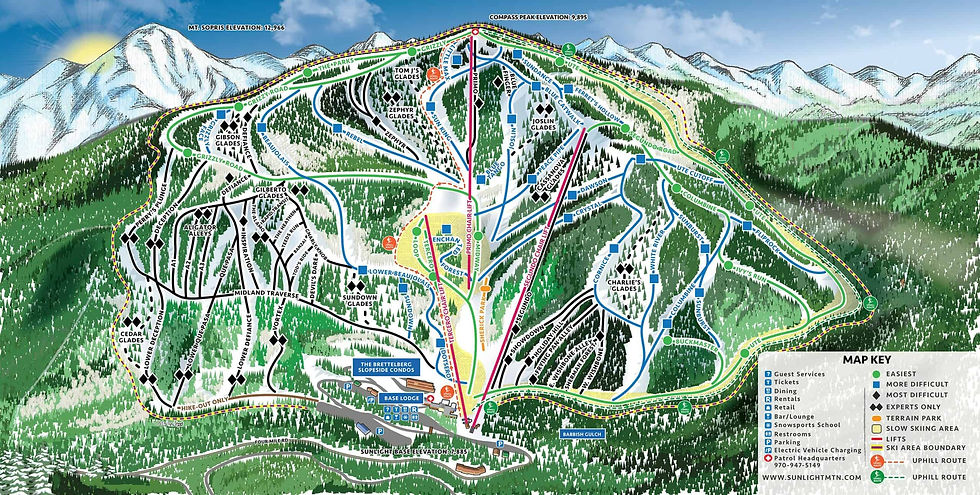
Sunlight is the smallest mountain on this list, with just 3 lifts and under 500 acres, but don't let the size fool you. It's still top rated and sees over 230 inches of snow a year, and the lower summit elevation, under 10,000 feet, makes it an easier adjustment if you're coming from sea level.
Pass: Indy Pass
Day pass: Generally $79 to $99, genuinely one of the most affordable full days of skiing in Colorado
Getting there: About 165 miles, roughly 3.25 hours from Denver, or fly into Aspen/Pitkin County Airport or Eagle County Regional Airport and drive from there.
Sunlight sits just outside Glenwood Springs, which might be the best hot springs town in the state. Ski Sunlight during the day, then soak your legs at Glenwood Hot Springs or Iron Mountain Hot Springs that evening. Glenwood also has a great downtown with breweries and restaurants, and it's conveniently right off I-70.
15. Purgatory Resort

Purgatory is located in Durango, an off the beaten path destination in the San Juan Mountains, the same range people call the Swiss Alps of Colorado. It's an older mountain with a classic, no frills feel, but it's a genuine Colorado favorite.
Pass: Power Pass (Mountain Capital Partners), not on Epic, Ikon, or Indy
Day pass: Generally $99 to $140 depending on the day
Getting there: About 330 miles, roughly 6.5 hours from Denver, or fly into Durango-La Plata County Airport (DRO), about 25 miles away, by far the easier way in
Terrain: A genuinely good spread from beginner to advanced across 1,600+ acres and 11 lifts.
Durango has several hot springs worth a soak after a day on the mountain, and the historic downtown has great food, shopping, and lodging if you want to make it a full trip rather than just a mountain day.
Prices, pass affiliations, and terrain stats change season to season, always double check with the resort directly before you book, but I updated this list as of Aug 2026.


Comments